Daniel Ibironke | Unreal Engine Games Designer
Jump and Solve
Software Used: Unreal 5, Microsoft Word, Piskel
Genre: Puzzle Platformer
Referenced Games: Human Fall Flat, Crash Bandicoot, Streets of Rage 4

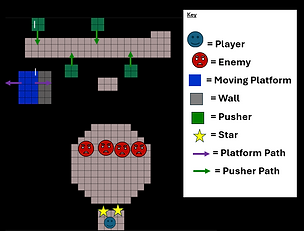

Overview
-
Solo puzzle platformer focused on simple interaction-based challenges.
-
Core mechanics include button pressing, box pushing, pressure plates, and respawn logic.
-
Puzzle design was inspired by Human Fall Flat.
-
Bonus tokens and slide movement were influenced by Crash Bandicoot.
-
Combat was included but kept secondary to the puzzle-platforming focus.
Design Focus
-
Designed puzzles around buttons, pressure plates, crates, and doors.
-
Used respawn mechanics to recover boxes if they fell out of bounds.
-
Included optional collectibles through bonus tokens.
-
Added light combat using a basic attack, charged heavy attack, and AOE star attack.
-
Prioritised puzzle solving over combat complexity.


Implementation
-
Built Blueprint Interfaces for buttons, pressure plates, and pickups.
-
Used inheritance for pickup types and button functions.
-
Created UI elements for the Main Menu, Pause Menu, Level Complete screen, and HUD.
-
Displayed player stats including death count, clear time, coins, stars, stamina, lives, keys, and bonus tokens.
-
Developed a Progress Manager for checkpoints, respawning, and status updates.
-
Created a player character with Mixamo animations, including a death animation.
-
Built two Game Modes: one for gameplay progression and one for the Main Menu.
-
Set up a Game Instance to carry data such as health, lives, and pickups across levels.

Problems Solved
-
Fixed infinite air sliding by checking whether the player was airborne.
-
Added a cooldown to stop slide spamming.
-
Used flowcharts to map pressure plate and door logic.
-
Added Boolean checks to track whether the player or crate was on a plate.
-
Placed small invisible cubes under crates to make movement smoother and prevent sticking.
-
Improved combat animation transitions by handling attack and stance montages directly in the character Blueprint.
Changes and Cut Features
-
Reworked the bonus round so it became part of the main level instead of a separate level.
-
Cut a second character with limited jumping and bullet-shooting due to scope.
-
Removed planned features such as a three-hit combo, platform-tilting mechanic, visible enemy health bars, and pressure-plate moving platforms.
-
Kept the final scope focused on the main puzzle-platforming loop.


Reflection
-
The project helped me practise Blueprint communication, UI tracking, and puzzle logic.
-
The biggest design lesson was keeping puzzle systems readable and avoiding unnecessary feature creep.